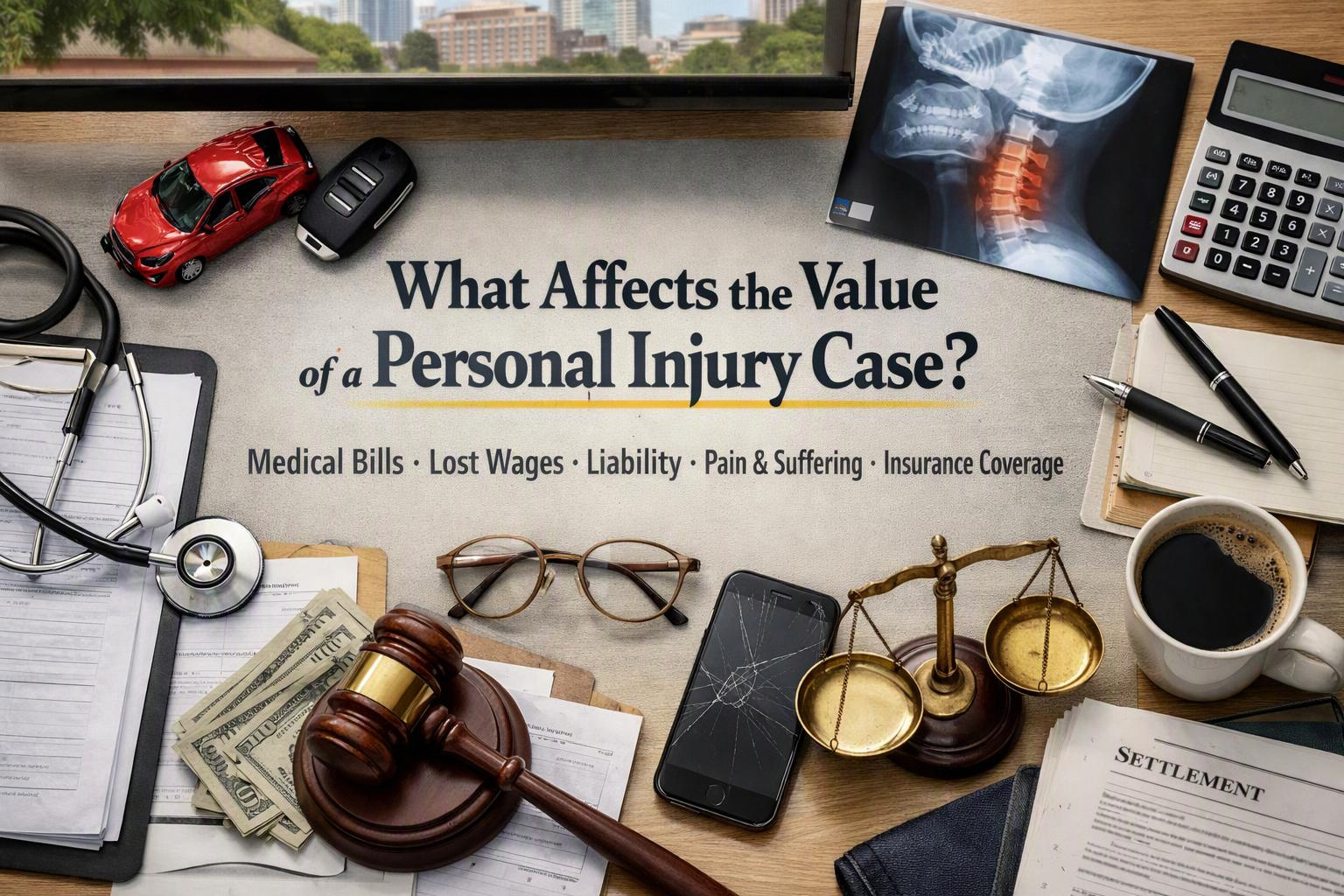
What Affects the Value of a Personal Injury Case?
Personal injury case value depends on proving fault, showing the injury’s severity and recovery impact, documenting financial losses, identifying available insurance, and presenting credible evidence. Atlanta Auto Law evaluates these factors together to assess damages and pursue an appropriate outcome.
Written by Ronnie Mabra
Request an EstimateWritten by Ronnie Mabra
What Determines the Value of a Personal Injury Case?
Personal injury case value is determined by the strength of liability evidence, the seriousness and consequences of the injury, the amount and proof of damages, available insurance, and the risks of resolving or trying the claim.
Liability asks whether another party’s negligence caused the incident. Causation connects that conduct to the injury, while damages show the financial and human effects that followed.
We review the evidence as a whole. Our team also considers insurance coverage, the strength of the claim, and whether settlement or litigation creates the better path toward a fair result.
Which Factors Can Increase or Limit Case Value?
Case value can increase when fault is clear, injuries are well documented, and losses are supported by reliable records. Value can be limited by shared responsibility, weak causation proof, gaps in treatment, or insufficient insurance.
| Factor | How it may affect value | What we review |
|---|---|---|
| Fault | Clear defendant fault can strengthen the claim. | Accident reports, statements, photographs, and other liability evidence. |
| Comparative negligence | Shared responsibility may reduce the amount recoverable under applicable law. | Each party’s conduct and the evidence supporting fault. |
| Injury severity | Serious or lasting harm may support greater damages. | Diagnosis, treatment, prognosis, impairment, and daily limitations. |
| Medical treatment | Consistent, medically supported care can help prove injury and recovery needs. | Medical records, bills, diagnostic testing, and treatment progress. |
| Lost income and future damages | Work disruption and future losses may increase economic damages. | Employment records, wage documentation, work capacity, and future care needs. |
| Pain and suffering | Physical pain and life disruption may support noneconomic damages. | Symptoms, emotional effects, restrictions, and recovery evidence. |
| Causation | A clear medical connection supports the claimed injuries. | Medical history, timing, testing, and expert opinions when needed. |
| Insurance policy limits | Available coverage can affect practical collectability. | Bodily injury insurance, underinsured motorist coverage, and other applicable policies. |
| Evidence quality | Complete, consistent proof can improve settlement and litigation positions. | Records, photographs, witnesses, reports, and recovery documentation. |
How Do Injury Severity and Recovery Affect Value?
Injury severity and recovery affect case value because lasting pain, impairment, disfigurement, treatment needs, and limits on work or daily activities can support greater damages when medical evidence connects them to the incident.
A temporary injury may affect work and daily life for a limited period. Permanent impairment or disfigurement can create broader effects, including future medical care and reduced work capacity.
We compare the initial diagnosis with the recovery prognosis. Our review also considers treatment intensity, ongoing symptoms, changes in daily activities, and the medical proof supporting future needs.
How Are Economic Damages and Pain and Suffering Evaluated?
Economic damages are evaluated through documented financial losses, while pain and suffering is evaluated through the injury’s physical, emotional, and functional effects rather than through a universal fixed amount.
Medical expenses may include treatment already received and supported future care. Lost wages and loss of earning capacity address work-related harm, while property damage may document related financial loss.
Pain and suffering damages can reflect physical discomfort, emotional distress, sleep disruption, limitations, and loss of enjoyment of life. We use medical records, personal accounts, work records, and other evidence to connect these effects to the incident.
Is There a Formula for Calculating Personal Injury Damages?
Personal injury damages do not follow one universal formula because the value depends on the evidence, injury consequences, financial losses, liability, applicable law, and available coverage.
A damages calculation may include economic damages, noneconomic damages, future losses, and the effect of causation disputes. The analysis must fit the facts of the individual claim.
We avoid relying on a generic multiplier or fixed estimate. Our team builds a case-specific evaluation from the records, legal issues, recovery outlook, insurance information, and risks of settlement or litigation.
What Evidence Supports a Stronger Injury Claim?
Strong injury claims use consistent evidence that proves fault, causation, damages, and the course of recovery. We organize the available proof so each claimed loss connects to the incident.
How Does Liability Affect the Amount You May Recover?
Liability affects recovery because a claim must connect another party’s legally actionable conduct to the injury, and the injured person’s share of responsibility can affect the amount recoverable under applicable law.
Negligence may involve conduct that failed to meet a reasonable standard of care. Causation requires proof that the conduct caused the injury and the claimed losses.
Comparative negligence and shared responsibility can create disputes about each party’s role. We examine the defendant’s conduct, the available liability evidence, and any argument that the injured person contributed to the event.
How Do Insurance and Settlement Factors Affect Case Value?
Insurance coverage affects practical case value because available coverage, the number of responsible parties, collectability, evidence strength, and litigation risk influence what can be pursued and resolved.
Bodily injury coverage may provide a source for recovery after a covered incident. Underinsured motorist coverage may also matter when the available liability coverage does not address the full extent of the loss.
Policy limits, multiple liable parties, and collectability can shape settlement negotiations. We weigh the evidence, likely defenses, cost and risk of litigation, and the strength of the settlement position before advising on strategy.
How Do We Evaluate What Your Personal Injury Case May Be Worth?
Atlanta Auto Law evaluates potential personal injury case value by investigating the incident, reviewing liability and medical evidence, documenting damages, identifying available coverage, and assessing resolution strategy.
Our team does not assign value from injury labels alone. We develop the evaluation from the claim’s evidence and the consequences the injury has created.
What Should You Do Before Discussing a Personal Injury Claim?
Before discussing a personal injury claim, seek appropriate medical care, preserve relevant evidence, document losses, and obtain legal guidance before making statements that could affect liability or damages.
Keep medical records, bills, employment information, photographs, accident reports, and communications connected to the incident. Follow medical recommendations and document changes in symptoms, activities, and work capacity.
Insurance communications can affect how an insurer interprets the claim. We help protect the evidence and consider the applicable statute of limitations before important deadlines affect the legal claim.
When you need guidance from a personal injury attorney, our team can review the facts and explain the factors that may affect potential recovery.
Questions About Personal Injury Case Value
Can a personal injury case be worth more after a permanent injury is diagnosed?
Yes, a permanent injury can support greater damages when medical evidence connects the impairment to the incident and shows its effect on future care, work capacity, daily activities, and quality of life. Atlanta Auto Law reviews the diagnosis, prognosis, treatment history, and supporting evidence before assessing the claim.
Does accepting medical treatment affect personal injury case value?
Yes, appropriate medical treatment can affect case value because medical records help prove the injury, causation, treatment needs, and recovery. Treatment decisions should follow medical guidance, and gaps or inconsistent records may create questions about the claimed harm.
Can missing work increase the value of a personal injury claim?
Yes, missing work can support lost wage damages when employment records and medical evidence connect the absence to the injury. A claim may also involve loss of earning capacity when the injury affects future ability to work.
Does a pre-existing condition reduce personal injury case value?
A pre-existing condition can create a causation dispute, but it does not automatically eliminate a claim. The key issues include the person’s condition before the incident, the change afterward, and the medical evidence connecting that change to the incident.
Can an insurance policy limit prevent full compensation for an injury claim?
Yes, an insurance policy limit can restrict recovery from that policy when damages exceed the available coverage. Other coverage, multiple liable parties, or collectible assets may affect the practical options, so we investigate the full insurance picture.
Atlanta Auto Law reviews liability, medical proof, financial losses, insurance coverage, and case strategy together. Contact us to discuss the facts and the evidence that may affect your potential recovery.
Get a Free EstimateRelated Resources
When a Workplace Injury May Involve a Third-Party Claim
What to AvoidCommon Mistakes That Can Hurt a Personal Injury Claim
Brand vs BrandPersonal injury attorney Companies Worth Comparing in Atlanta (2026)
Brand vs BrandAtlanta Auto Law vs Local Personal injury attorney Alternatives in Atlanta: Side-by-Side Comparison